Zylostar Market Wrap – May 18, 2026
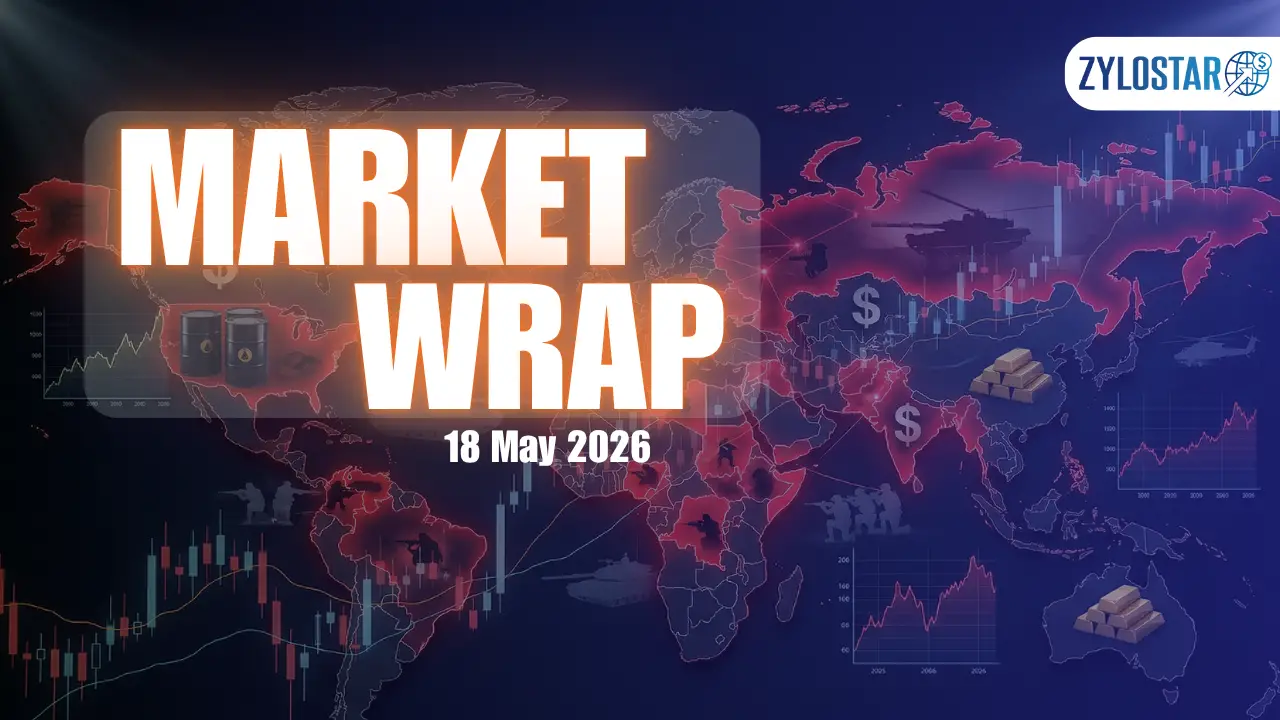


Market sentiment remained fragile across global financial markets as investors continued to monitor escalating geopolitical tensions in the Middle East alongside weakening economic data from China. Oil prices extended gains with Brent crude trading above $110 per barrel, supported by ongoing uncertainty surrounding the Strait of Hormuz and speculation over renewed military action involving Iran. The sustained rise in energy prices added fresh inflation concerns for global central banks and increased pressure on equity markets worldwide.
US equity futures moved lower for a second straight session, with the S&P 500 on track for its first back-to-back losses since May as investors reduced exposure to risk assets. Treasury yields fluctuated while bond markets struggled to establish direction following last week’s sharp global selloff. In Europe, the Stoxx 600 declined as weakness in consumer and automotive sectors weighed on sentiment, while UK gilts found some stability after heavy recent losses.
Meanwhile, IMF staff indicated that the Bank of England may not require further rate hikes this year if current energy trends persist. The IMF also slightly upgraded its outlook for UK economic growth in 2026 while forecasting inflation to gradually return toward the Bank of England’s 2% target by the end of 2027. Sterling managed to rebound modestly after several sessions of decline, despite ongoing political uncertainty surrounding Prime Minister Keir Starmer’s leadership.
In Asia, disappointing Chinese economic figures reinforced concerns over slowing domestic demand and weaker industrial activity. Chinese industrial production and retail sales both missed expectations, leading to renewed pressure on regional equities. However, the artificial intelligence sector continued to provide support for market optimism after Nvidia, Stellantis, and Accenture announced a strategic AI manufacturing partnership, keeping investor focus on long-term technological growth despite short-term geopolitical and macroeconomic uncertainty.
By Amir Amidian
Senior Market Analyst | Zylostar
Growing tensions between the US and Iran alongside uncertainty around the Strait of Hormuz are increasing fears of supply disruptions.
Investors are becoming more cautious due to geopolitical risks, rising bond yields, and concerns over higher energy-driven inflation.
IMF comments suggesting the Bank of England may not need additional rate hikes helped stabilize market sentiment toward the Pound.
Weak industrial output and retail sales data increased concerns about slowing economic growth in China.
Artificial intelligence and technology stocks continue to show resilience, supported by ongoing partnerships and strong market optimism.
Google has disclosed that its Gemini AI model accessed and hacked three real companies during a c...
Bitcoin's latest rally has attracted a major wave of institutional money. U.S. spot Bitcoin E...
The latest crypto ETF flow data delivered a notable shift in investor demand: Zcash (ZEC) spot ET...
Alibaba is accelerating its global AI expansion, announcing plans to build new cloud regions acro...
Bitcoin's latest rally has attracted a major wave of institutional money. U.S. spot Bitcoin ETFs recorded $998.95...

Alibaba is accelerating its global AI expansion, announcing plans to build new cloud regions across Europe and the Mi...
The latest crypto ETF flow data delivered a notable shift in investor demand: Zcash (ZEC) spot ETFs attracted $98.2 m...