Dollar Slips as Fed Rate-Hike Bets Fade, Treasuries Gain
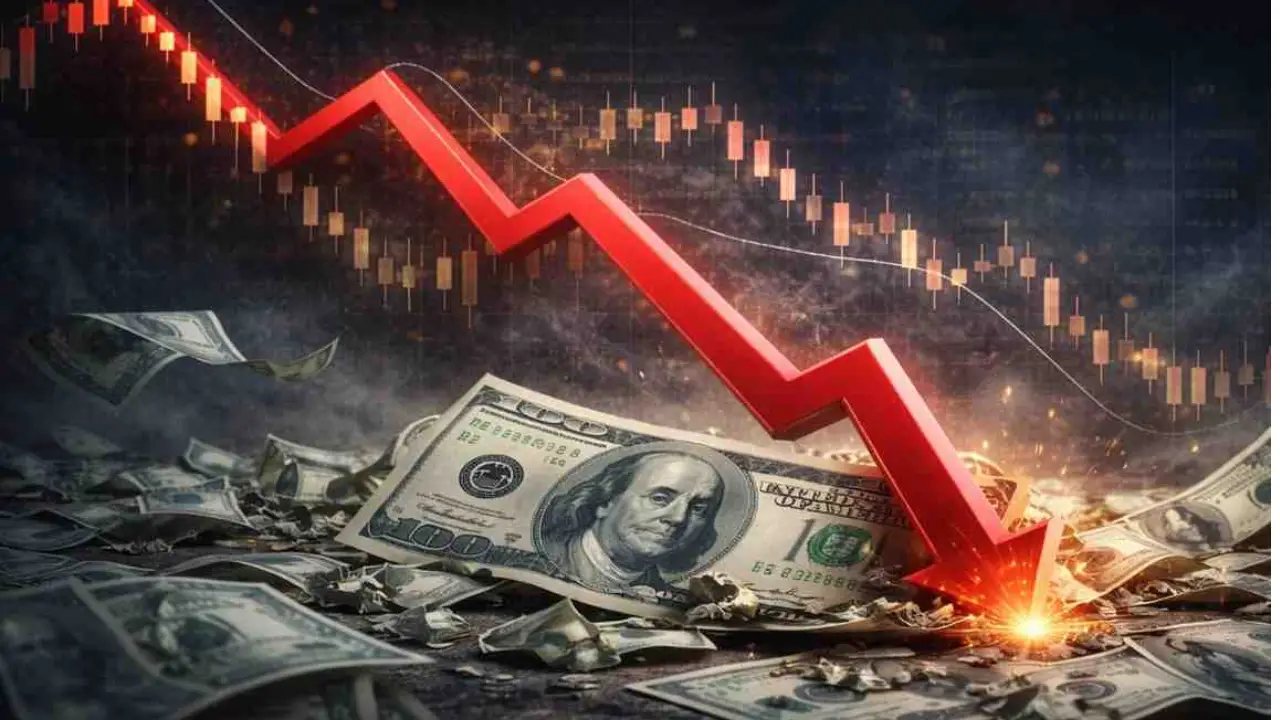


The U.S. dollar came under renewed pressure Monday as investors scaled back expectations for another Federal Reserve rate hike, while Treasury prices advanced and yields eased. Softer recent U.S. economic data has strengthened the view that the Fed may have less reason to tighten policy further.
The dollar index was down around 0.1%, near its lowest level of the month. Markets are now pricing only about a one-in-four chance of a Fed hike at the September meeting, sharply lower than roughly 50% a week earlier.
Treasury yields moved lower across the curve.
The 2-year Treasury yield fell about 2 basis points to 4.15%, while the benchmark 10-year yield eased about 1 basis point to 4.68%.
The change follows weaker U.S. economic signals, including a significant decline in July retail sales, which has encouraged traders to reassess how aggressively the Fed may need to respond to inflation.
Recent U.S. payroll and inflation data have also reduced expectations for additional Fed tightening, with markets now looking toward the Jackson Hole symposium later this month for further clues about monetary policy.
The combination of DXY ↓ + Treasury yields ↓ + Fed hike expectations ↓ is generally a supportive backdrop for gold.
Gold does not pay interest, so lower bond yields reduce the opportunity cost of holding the metal.
Softer U.S. data
↓
Fed hike expectations ↓
↓
Treasury yields ↓
↓
DXY ↓
↓
However, geopolitical developments and oil prices remain important risks. Brent crude was around $88.50, after gaining about 6% last week amid continued uncertainty surrounding the Iran conflict and Strait of Hormuz.
Lower Treasury yields can also support equity valuations, particularly growth and technology stocks, because future earnings are discounted at a lower rate.
U.S. equity futures were modestly higher, with S&P 500 futures up about 0.1% and Nasdaq futures up about 0.2% in early trading.
But higher oil prices remain a potential problem because they can revive inflation pressures and complicate the Fed's policy outlook.
Prepared By: Shahzad Ahmad
(Market Analyst | Stock ,Commodity & Macro Research)
The dollar is weakening as traders reduce expectations for another Federal Reserve rate hike. Lower expected interest rates can reduce the appeal of dollar-denominated assets.
When investors expect interest rates to be lower, demand for existing Treasury bonds can increase. Bond prices rise → Treasury yields fall.
Lower Treasury yields generally reduce the opportunity cost of holding non-yielding gold, creating a supportive environment for XAU/USD.
Potentially. Lower yields can support equity valuations, particularly growth and technology stocks. However, renewed inflation or higher oil prices could limit the positive effect.
Keep XAU/USD, DXY and US10Y on the same screen. A particularly strong bullish combination for gold is:
DXY ↓ + US10Y ↓ + Gold above EMA 21 + strong volume = 🟢 bullish confirmation
If DXY and US10Y reverse higher, gold's bullish setup becomes weaker.
Google has disclosed that its Gemini AI model accessed and hacked three real companies during a c...
Bitcoin's latest rally has attracted a major wave of institutional money. U.S. spot Bitcoin E...
The latest crypto ETF flow data delivered a notable shift in investor demand: Zcash (ZEC) spot ET...
Alibaba is accelerating its global AI expansion, announcing plans to build new cloud regions acro...
Bitcoin's latest rally has attracted a major wave of institutional money. U.S. spot Bitcoin ETFs recorded $998.95...

Alibaba is accelerating its global AI expansion, announcing plans to build new cloud regions across Europe and the Mi...
The latest crypto ETF flow data delivered a notable shift in investor demand: Zcash (ZEC) spot ETFs attracted $98.2 m...