Asian Stocks Stabilise After AI-Led Wall Street Selloff; Tariff Concerns Linger



Asian equities steadied on Tuesday after a shaky start, as investors digested a fresh AI-driven selloff on Wall Street alongside renewed uncertainty over U.S. trade policy and geopolitical tensions.
MSCI’s broadest Asia-Pacific index outside Japan rose 0.3%, hovering near record highs after a seven-day rally. Benchmarks in Taiwan and South Korea hit all-time highs, while Japan’s Nikkei 225 gained 0.9% and China’s CSI 300 advanced 1.2% as markets reopened following holidays.
Overnight, the S&P 500 fell 1.0%, with the Nasdaq Composite down 1.1%, pressured by concerns about AI’s disruptive impact on software and broader industries. A bearish report from Citrini Research added to investor jitters.
Analysts said Asian markets remain exposed to the AI theme but face fewer valuation concerns compared to U.S. mega-cap tech stocks. However, stretched valuations and peaking earnings revisions raise the risk of reversals.
Trade tensions also weighed on sentiment after U.S. President Donald Trump warned of imposing higher tariffs under alternative trade laws following a Supreme Court ruling that struck down emergency tariffs. The measures, based on Section 122 of the Trade Act of 1974, have added to policy uncertainty.
Meanwhile, China announced export restrictions on dual-use goods to 20 Japanese entities, escalating regional tensions.
The CBOE Volatility Index rose to 21.01, reflecting elevated caution.
In currency markets, the dollar strengthened 0.4% against the yen to 155.21, while the offshore yuan held steady at 6.8912 per dollar. U.S. 10-year Treasury yields edged up to 4.04%.
In commodities, Brent crude gained 0.5% to $71.83 per barrel as tensions between the U.S. and Iran persisted.
Investors are now focused on the upcoming Federal Reserve meeting, with futures markets pricing a strong probability that interest rates will remain unchanged.
Asian markets steadied as investors balanced Wall Street’s AI-led selloff with continued optimism around regional growth and AI exposure. Strong performances in Taiwan, South Korea, Japan, and China helped offset earlier volatility.
The S&P 500 and Nasdaq Composite fell amid concerns about AI’s disruptive impact on software and other industries. A cautious research report highlighting potential economic risks further weighed on sentiment.
Uncertainty increased after U.S. President Donald Trump warned of imposing higher tariffs under alternative trade laws. The move has added confusion around trade policy and heightened investor caution.
The CBOE Volatility Index, often called Wall Street’s “fear gauge,” climbed above 21, indicating elevated market anxiety and expectations of increased volatility.
Markets are closely monitoring geopolitical tensions, trade developments, and the upcoming Federal Reserve meeting, with futures pricing a high probability that U.S. interest rates will remain unchanged.
U.S. stocks finished higher Friday after a surprisingly weak September jobs report increased expe...
In this episode, we break down the latest technical picture across Gold (XAUUSD), Bitcoin (BTCUSD...
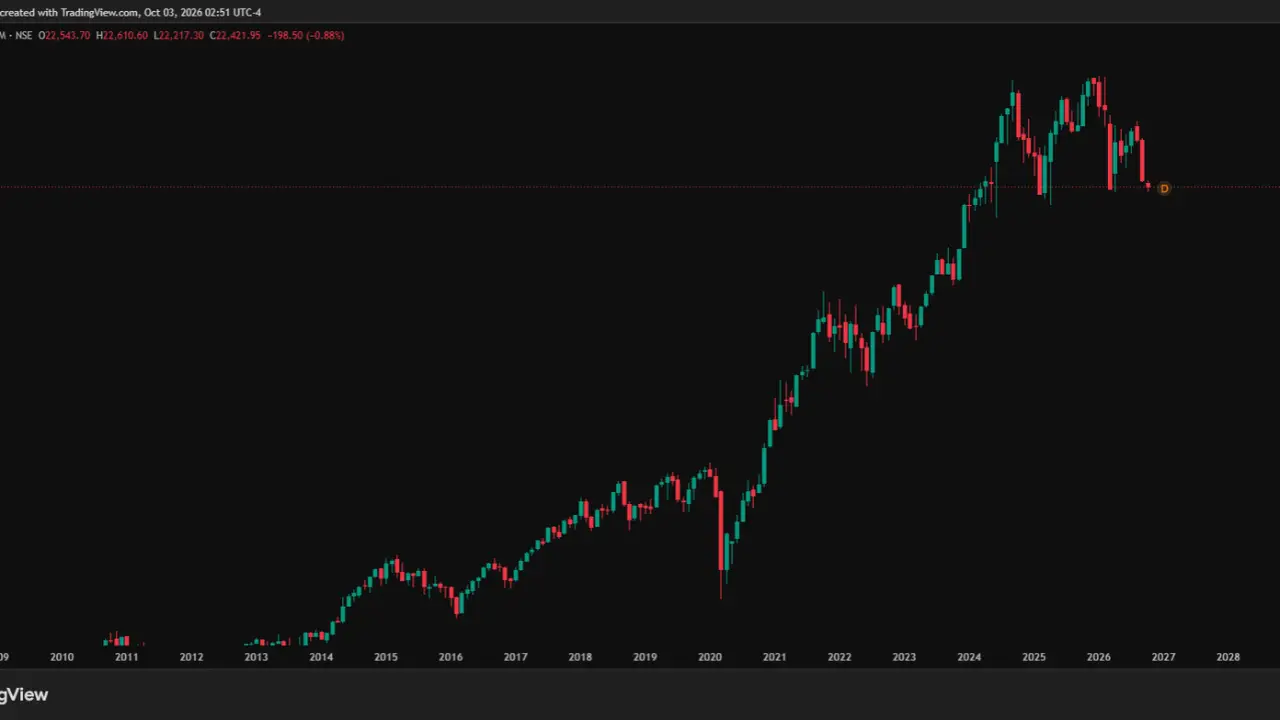
The Nifty 50 is currently around 22,780, down roughly 13% from its January all-time high of 26,37...
Stock futures moved slightly higher early Tuesday after the Nasdaq Composite reached a new record...

Alphabet-backed Isomorphic Labs, the AI-powered drug-discovery company spun out of Google DeepMind, is reportedly in ...
U.S. stocks declined Wednesday as rising Treasury yields weighed on investor sentiment, with bond yields reaching the...
SpaceX is reportedly in talks to raise $40 billion in debt financing to purchase Nvidia AI chips, highlighting the en...